
Labette VINELink Custody Coverage
Kansas VINE is a free notification system for adults held in Kansas county jails. The Labette County Sheriff links directly to VINE from inmate profiles, which connects registration to the correct jail episode. It can report release, transfer, and other custody changes. It is not the Kansas Department of Corrections notification program.
A person sentenced from Labette County may leave the jail for KDOC. Once state-prison custody applies, use KASPER for public status and KDOC victim notification for alerts. Federal custody requires the BOP locator. Public sources do not promise a historical VINE archive after a person leaves the searchable system.
Search Labette VINELink by Person
Begin with the Kansas portal or the VINE control on a Labette sheriff profile. A booking number, exact name, age, and photograph help separate namesakes.
- Select Kansas and search the person’s name.
- Confirm that the custodian is Labette County Jail and compare the result with the sheriff profile.
- Open the match and read its status as a dated report from that system.
- Register only after the person and jail episode are matched. Save the booking number and lookup date.
- If no result appears, check the sheriff Released view, call the jail, or move to KASPER when transfer is possible.
The Labette released-inmate search separates county, state, and federal paths. Saved notices and agency records matter after a rolling result expires.
Labette VINELink Release Evidence
VINE reports a custody event from the participating jail. It does not supply the full reason behind the move. Pair an alert with the sheriff timestamp, court order, receiving-agency record, or jail confirmation.
| Item | What it supports | What it cannot prove |
|---|---|---|
| Name and identifier | Matching a jail episode | Identity without comparison |
| Custody status | The jail’s reported state | Freedom from all holds |
| Facility | Which jail supplied the event | Every later destination |
| Release or transfer notice | A custody change | That the person went home |
| Notice time | Message delivery | Exact event time unless stated |
Labette’s Released card adds the booking number, booking and release times, charges, bond, and photo, but not reason or destination.
Register for Labette Release Alerts
Kansas guidance supports phone and email notices. Phone registration uses a four-digit PIN. A recorded call repeats until that PIN is entered. Current Kansas sources support 1-866-574-8463; an older sheriff page shows a different number, so use the current state guide.
- Open the matched Labette result.
- Select registration and choose phone or email.
- Enter contact details and retain the four-digit PIN.
- Review the person and facility before submitting.
- After an alert, verify the event with the jail or receiving system.
The sheriff’s VINE page documents direct profile integration.
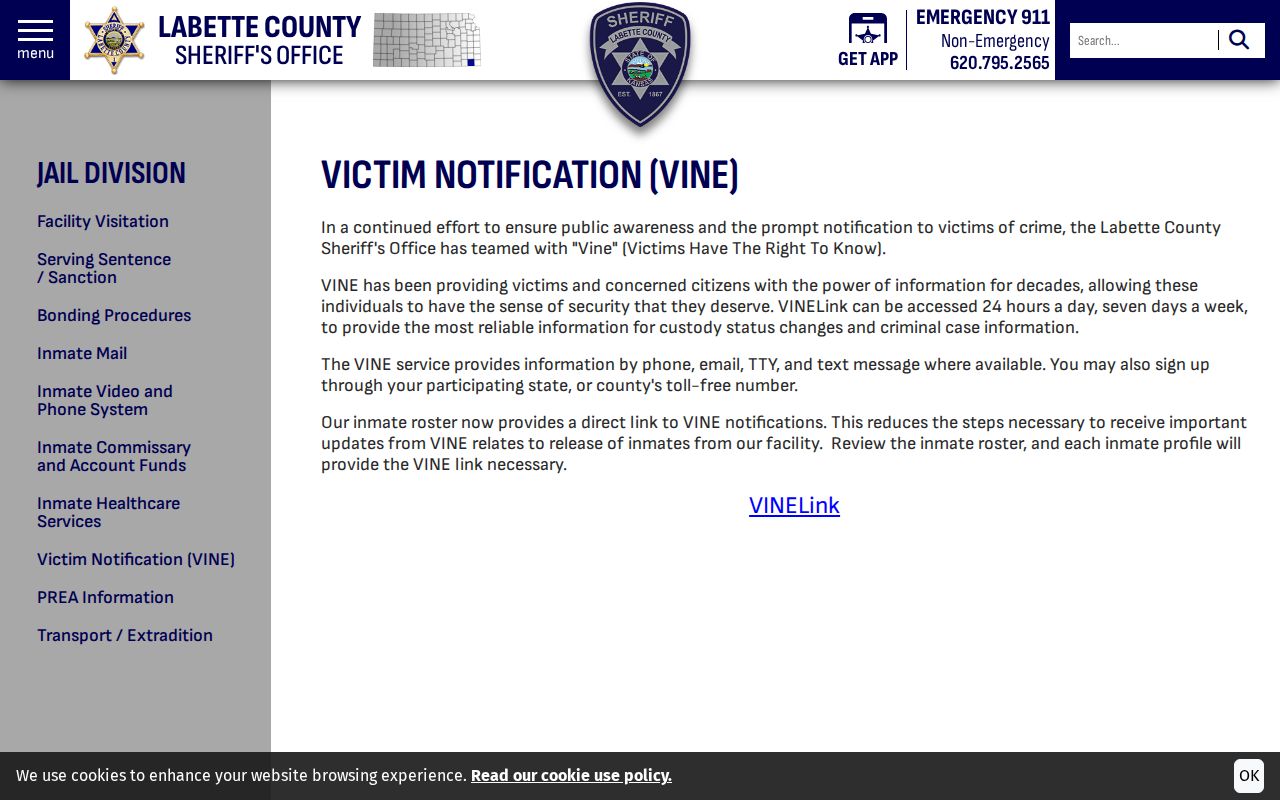
The direct link lowers matching risk by starting from the relevant sheriff profile.
Confirm Labette VINELink Changes
A transfer is the main local false positive. Labette County Jail holds people awaiting KDOC transport and contract detainees from other jurisdictions. Deputies also conduct court, medical, and extradition moves. A VINE change can end county custody while another agency begins custody.
Call the jail at 620-795-2565 or its bond line at 620-795-2997 when destination matters. Search KASPER after a KDOC transfer, allowing for working-day updates. For an older event, request admission and release times, release type, authority, and transfer destination if public.
Labette Profiles Link to VINE
Labette County’s direct profile control is the distinctive local layer. Search the sheriff roster first, open the matching profile, then follow its VINE link. This keeps the jail identity, booking facts, and notification record tied together.
If the person vanishes from Current, do not infer release. Check Released and the home-page card, save any VINE message, and compare the timestamp. A court docket may explain authority, but the custody-event record proves the transition. After transfer, move to the receiving system.
Labette State Notification Split
KASPER covers people associated with KDOC programs, while KDOC’s form handles state notification. KASPER can be narrowed by KDOC number, birth data, conviction county, and supervision county. It updates on working days and may lag a same-day transfer.
KDOC’s separate form confirms the split.

A county VINELink registration should not be expected to follow a person through a state-prison sentence.
When Labette VINELink Finds Nothing
A failed search has several possible causes. The person may already have left the rolling county system. A name may be entered differently, a namesake may obscure the match, or an event may not yet have propagated. The person could also be in KDOC, federal, immigration, or another county’s custody. None of those situations proves community release.
Return to the known identifier. The sheriff roster uses a booking number for the local jail episode. KASPER uses a KDOC number. Federal records use a BOP register number, and immigration records may use an A-number. Search the system tied to that identifier and preserve its wording. If a known Labette booking is absent, call the jail and ask whether the episode ended through release or transfer.
For a past event outside the public window, send a focused request to the sheriff. Ask for admission and release timestamps, release reason or type, releasing authority, and destination if maintained and public. A saved VINE message can narrow the date, but the agency record is stronger evidence.
Follow a Labette Transfer Alert
A transfer notice should start a second search. Labette’s jail holds people awaiting KDOC transport after felony sentences and contract detainees from other jurisdictions. Deputies also handle extraditions and moves to court or medical destinations. The county system can close one episode while another opens.
- Save the VINE message and note when it arrived.
- Preserve the sheriff booking number and release timestamp.
- Call the jail for the receiving jurisdiction when public.
- Search KASPER after a KDOC move or the receiving county’s roster after a local transfer.
- Use the new custodian’s notification program for later changes.
This chain can produce three valid records: a VINE notice, a Labette release timestamp, and a receiving-agency entry. They document successive stages. Do not force each system to display the same status because each records a different event.
Pair Labette Alerts with Court Records
The Kansas district-court docket can explain why release was authorized. A bond order, dismissal, sentence, revocation, or transport order may appear there. Yet an order does not always prove when jail staff completed processing, and it does not rule out another hold. Pair legal authority with a sheriff custody event.
Labette County is in the 11th Judicial District, with court locations in Parsons and Oswego. Search by case number when possible. Several booking charges may connect to several cases. Sealed, expunged, juvenile, and other protected matters may not appear publicly.
If VINE and a court entry seem to conflict, describe each source in its own terms and check the jail. A Monday order and Tuesday VINE notice may reflect processing time. A transfer alert and later KASPER entry may correctly show movement into state custody.
Read Labette Notifications Carefully
A direct VINE notice is useful corroboration because it comes from the participating custody system. For a Labette jail episode, the sheriff’s custody-event record is stronger for the exact time. A court order establishes authority. A receiving-agency record establishes later custody. Together, they provide a more complete account.
Sheriff cards use local Kansas time. Preserve that timestamp as displayed. Also record when the page was checked. A live result can change, a released entry can expire, and a later correction can make an undated screenshot misleading.
- Release
- The county system reports that its jail episode ended or changed.
- Transfer
- Custody moved to another agency.
- Notification
- A message about a reported event that needs verification.
- Discharge
- The formal end of a sentence or supervision.
Recover Older Labette Custody Changes
VINELink is built for current notice, not as a promised archive. When an alert is old or the result no longer appears, use the saved message to frame a sheriff records request. Include the full name, booking number, approximate dates, and the exact event being sought. Ask for electronic records and a fee estimate.
Kansas public-record law requires the custodian to act on a request by the end of the third business day through production, denial, or a delay explanation. That rule does not promise full production within three days. Protected parts can be separated from public custody-event data.
The district-court docket is a durable connector when the rolling jail entry is gone. It can show an order that authorized release, but it should still be paired with the sheriff timestamp. If the case is absent, consider name variants and access restrictions before claiming the event never occurred.
Federal Custody Needs Another Locator
Kansas VINELink does not cover federal prisoners. The BOP Inmate Locator can report current federal custody or a released/not-in-custody result for people in its historical scope. A BOP no-custody result applies only to BOP. Another jail, immigration system, or supervision authority may still apply.
For an immigration lead, ICE’s locator has its own identifier and scope limits. PACER supplies federal court orders, while the U.S. Marshals Service or holding facility may close a short-term physical-custody gap. Use system-specific language and never turn one negative result into a universal release claim.
Public Record Search
Sponsored Results