
Labette Projected Versus Actual Release
A projected date is a sentence-administration estimate based on the law, sentence, jail credit, and credits then recorded. An actual release is a completed custody event. Kansas law uses “projected release date” in K.S.A. 22-4401, while regulations and sentence types also distinguish conditional-release, guidelines-release, parole-eligibility, and maximum dates. Those labels should not be merged.
A person awaiting trial has no standard KDOC projection. Bond, a dismissal, a plea, sentencing, or another court order may change county custody. A Labette jail release timestamp proves that the booking episode changed, but it does not state that the person went home.
Find a Labette Release Projection
KASPER is the Kansas public search for people associated with KDOC-operated or funded programs. Its form accepts name, alias, KDOC number, birth data, conviction county, and parole-supervision county. Labette is selectable. The automated research did not verify the exact live result label behind reCAPTCHA, so do not assume a displayed field name.
- Decide whether the person is in Labette County Jail or KDOC custody.
- For KDOC, search by KDOC number or match a name with birth and conviction data.
- Record the exact date label, status, and lookup date shown in the live result.
- Compare the result with the Labette sentencing docket and later amendments.
- For a county sentence, call the jail or request its computation and custody-event record.
The Labette release search explains how to trace a completed county event. KASPER is not a complete criminal history and may update only on working days.
Kansas Credits Shape Labette Projections
K.S.A. 21-6821 generally caps good-time credit for specified guidelines prison terms at 15 percent, which produces the familiar 85-percent shorthand. That shorthand is not a calculator. Program credit, jail credit, forfeiture or restoration, sentence aggregation, amended journal entries, appellate action, and the governing version of the law can change the official result.
Older indeterminate sentences use different parole and conditional-release concepts. K.S.A. 22-3725 addresses pre-guidelines good-time calculations, while K.S.A. 22-3717 addresses parole eligibility and postrelease rules. A parole-eligibility date is merely when a qualifying case may be considered. A Board hearing list is not a release decision.
The Kansas good-time statute is captured below.
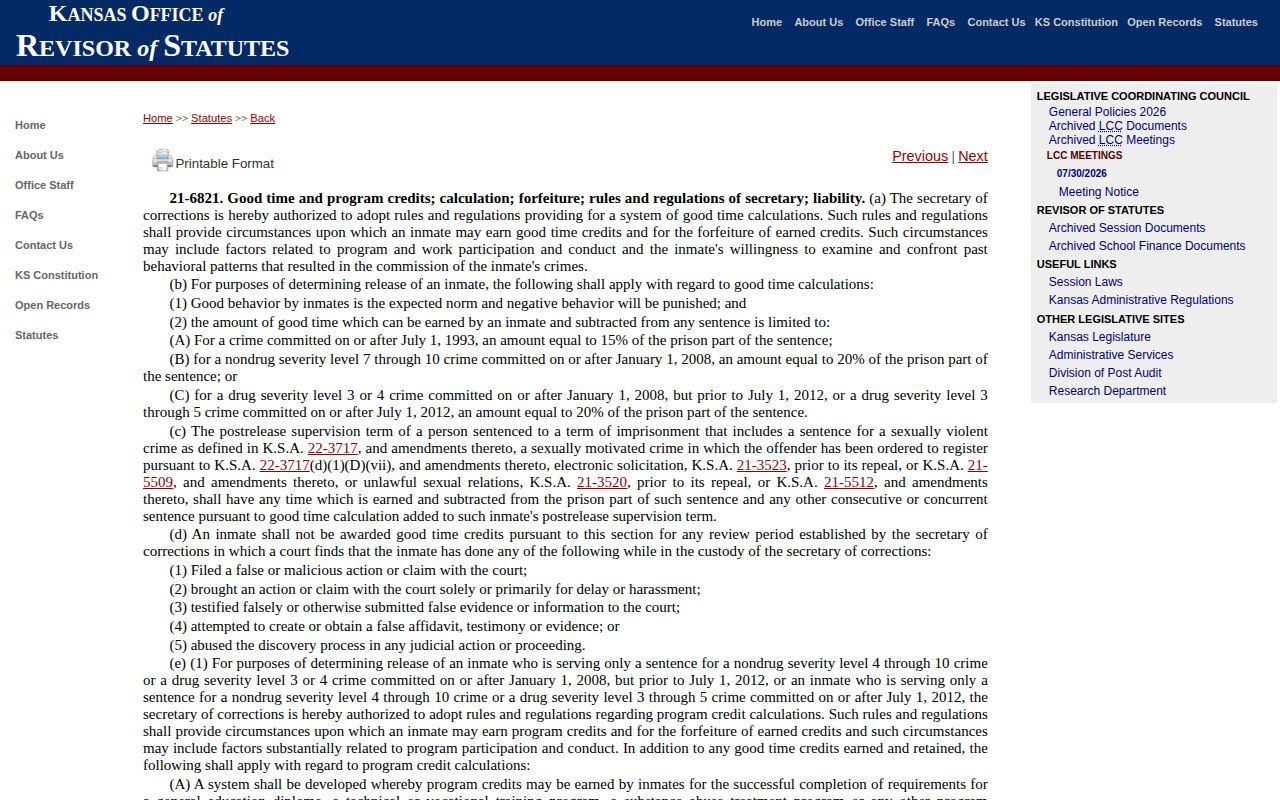
The statute supports the cap and credit framework, not an unsourced personal computation.
Why Labette Release Dates Change
An official projection can lawfully move. State which record reports each date instead of replacing one with another.
| Factor | Possible effect | Record to check |
|---|---|---|
| Good-time award or loss | Moves the computed date within governing law | KDOC sentence computation |
| Program credit | May reduce the prison portion when authorized | KDOC credit record |
| Jail credit | Changes time credited before prison | Journal entry and KDOC calculation |
| Amended court order | Changes sentence terms or counts | Labette docket |
| Detainer or transfer | May prevent community return | Custody-event and receiving agency |
| Parole action | May authorize, continue, or defer a release process | Prisoner Review Board record |
A favorable parole action remains subject to processing and conditions. Final discharge may occur much later than release from confinement.
Confirm Labette Release Dates
Recheck KASPER when a projected state date arrives. A same-day unchanged result is not final because working-day updates can lag. KDOC Records, the state notification program, and the supervising office are the next channels. If the record changes to postrelease supervision, preserve that transition apart from later final discharge.
For Labette County Jail, use the sheriff Released view, call 620-795-2565, or request the custody event. Kansas VINE covers county-jail changes, while KDOC has a separate state-prison notification route. The VINELink inmate search explains that boundary.
Labette Jail Dates Use Local Records
Do not apply KDOC’s 15-percent cap to a county-jail stay by assumption. Labette’s public sources do not publish a county sentence-credit formula, weekend-release policy, release time, or holiday practice. Ask the jail for the calculation and compare it with the court’s sentencing order.
The jail also holds felony-sentenced people awaiting KDOC transport. A sheriff release timestamp can therefore describe transfer to state custody rather than return to the community. Search KASPER after allowing for its update cycle and keep both events in sequence.
Labette Eligibility Is Not Release
The Prisoner Review Board public-comment schedule proves that a process is scheduled, not that release has been granted. Protected preparole and supervision material does not become public merely because an offender appears on a hearing list. Use the Board process page, the applicable version of K.S.A. 22-3717, and later KDOC status.
No public individual decisions database was found. A focused request may seek the public act or outcome, while K.S.A. 22-3711 protects specified reports and histories. This distinction prevents a hearing month from being published as a release month.
Labette Sentence Types Set Dates
Kansas sentence type controls which date matters. An older indeterminate sentence can involve parole eligibility, a Board decision, conditional release, and maximum discharge. A guidelines sentence generally has a prison portion followed by mandatory postrelease supervision. The date confinement ends is not the date every legal obligation ends.
Parole eligibility means a qualifying person may be considered. It is not a grant. A favorable Board decision authorizes release subject to processing and conditions. Mandatory postrelease begins when the guidelines prison portion ends. Conditional release and maximum discharge arise from different computations. Read the governing version of the statute and the verified public display rather than selecting the earliest date.
- Projected release
- A computed future custody date that may change.
- Parole eligibility
- The point when an older qualifying sentence may be considered.
- Postrelease supervision
- Mandatory supervision after the prison portion of a guidelines sentence.
- Final discharge
- The formal end of the sentence or supervision.
Search KASPER for Labette Records
KASPER’s verified form accepts first, middle, and last name, alias selection, and KDOC number. Advanced fields include a Social Security number match, State ID or KBI number, race, gender, birth date, age range, conviction county, and parole-supervision county. Results may be requested with photos and thumbnails. Use only the fields needed to separate the correct person.
Labette as conviction county does not establish where a person is now held or supervised. A KDOC number is the strongest public matching identifier for the state record. A booking number belongs to a separate county-jail episode. Preserve both when a Labette release was followed by transport to state custody.
KASPER’s disclaimer limits the repository to people and cases connected to KDOC-operated or funded programs. It is not the right primary source for a person who only spent time in Labette County Jail. It may also be inaccessible behind reCAPTCHA or temporarily stale. Use KDOC Records, the court docket, and a later interactive check as fallbacks.
Compare Labette Release Date Evidence
Different records answer different questions. A sheriff release timestamp is strongest for the end of a Labette booking. The court journal entry supplies sentencing authority and credits ordered by the judge. KDOC maintains the state sentence computation. KASPER is the public derivative used for navigation. A Board calendar shows only a scheduled process.
| Source | Best use | Key limit |
|---|---|---|
| Labette sheriff profile | Completed county custody event | May omit reason and destination |
| District-court docket | Sentence and amended orders | Does not prove actual departure time |
| KDOC calculation | Official state sentence administration | May require a focused request |
| KASPER | Public KDOC status search | Working-day lag and scope limits |
| Board hearing list | Scheduled parole process | Not a decision or release date |
When official dates conflict, report which source supplies each one and request reconciliation. Do not silently choose the date that appears most favorable or easiest to explain.
When a Labette Date Arrives
Suppose a state projection arrives. Recheck the KDOC public record and save the displayed wording and lookup date. Compare the Labette sentencing docket for amended journal entries, sentence aggregation, and jail credit. If the date passes without an immediate public change, remember that KASPER updates on working days. Contact KDOC Records or the relevant institution rather than declaring the date missed.
If status later changes to postrelease supervision, record the end of confinement and the start of supervision as separate events. K.S.A. 22-3722 supplies a certificate route for final discharge in specified cases. That later certificate should not be backdated to the day of physical release.
A county scenario is different. If a person leaves the Labette Current roster, search Released and the home card for a timestamp. Call the jail when no matching card appears. A court order can support the legal authority, but absence from Current does not establish that the person went to the community. The person may have transferred to KDOC or another jurisdiction.
Request a Labette Date Record
For KDOC, include the name and KDOC number and ask for custody status, release-to-supervision date, discharge date, the relevant public sentence-computation record, and a discharge certificate or order if maintained. Request electronic form, a fee estimate, and public segregable portions. For Labette County Jail, use the booking number and ask for the admission and release timestamps, release type, authority, transfer destination, and detainers reflected at release.
A narrow request produces a clearer answer than asking for an entire file. Kansas law permits fees and requires action, denial, or a delay explanation by the end of the third business day. It does not guarantee that all requested records are open or that production will finish within that period. Preserve the response because a later correction can explain why an earlier public projection changed.
Public Record Search
Sponsored Results