
Understanding Labette County Releases
A Labette County Jail release closes or changes one booking episode. It does not always mean the person went home. The jail holds people before and after trial, short county sentences, felony-sentenced people waiting for Kansas Department of Corrections transport, and contract detainees from other jurisdictions. It also books municipal arrests from Altamont, Chetopa, and Oswego, plus Parsons when needed. A person can leave the current roster through bond, a court order, completion of a sentence, transfer, extradition, or another agency taking custody.
The strongest proof ties an exact release timestamp to the right booking number. Then identify the destination. The sheriff's Released profile, VINE, a court order, KASPER, and a receiving agency each answer different parts of the question. A court order may show why release was authorized, but the jail record shows when its custody changed. A later KASPER entry may show that the county episode ended because state custody began.
Release terms
Time served means credited confinement satisfies the ordered jail term. Parole is supervised release used for eligible sentence types. Probation is court-ordered supervision in place of, or after part of, confinement. Discharge is the later formal end of the sentence or supervision.
Labette County Release Paths
The next search depends on the event that ended the Labette booking. Do not infer that event from a blank Current search or from the bond amount alone. The public release card does not state a reason or destination, so a profile, staff confirmation, court entry, custody-event record, or receiving-agency record may be needed.
| Release path | Meaning | Next check |
|---|---|---|
| Bond or recognizance | A court-approved condition permits departure after processing. | Sheriff timestamp and court docket. |
| Dismissal or court release | An order changes the basis for confinement. | Court order plus jail confirmation. |
| Time served | The ordered county term and applicable credit have ended. | Journal entry and custody-event record. |
| Probation | The court orders community supervision. | Court Services or Community Corrections. |
| KDOC transfer | Labette custody ends as state custody begins. | KASPER and KDOC records. |
| Other transfer or detainer | Another jail or agency receives the person. | Receiving system and jail confirmation. |
Labette County Release Record Fields
The sheriff's card supplies a useful minimum record for a recent Labette County release. Match several fields because names can be shared and one person can have more than one booking. The photograph is an identity aid, not conclusive proof. Most important, the release date belongs to that booking episode. It is not a final discharge date from every sentence.
| Field | What it shows |
|---|---|
| Name, age, photograph | Public matching aids for the displayed person. |
| Booking number or inmate ID | The key for separating one jail episode from another. |
| Booking date and time | When that admission was recorded. |
| Release date and time | When the sheriff system closed or changed that episode. |
| Charges | The allegations or case context linked to the booking. |
| Bond amount | Displayed bond information, not proof of the release reason. |
| Profile and VINE control | A route to booking details and custody notifications. |
The public card does not establish reason, destination, releasing authority, property return, supervision, or whether another detainer applied. Request those items when they matter. State-prison release also differs from final discharge. Kansas postrelease supervision begins after prison, while a later order or certificate can document final discharge.
Request Labette County Release Records
The sheriff does not publish a request form, fixed copying charge, release-record retention schedule, or promised production time. Records Clerk Amber Vance is named on the records page. Send a focused Kansas Open Records Act request to the Labette County Sheriff's Office, 718 5th Street, Oswego, KS 67356, or use its official contact channel.
- Give the name, approximate custody dates, and booking number.
- Ask for the booking or custody-event record and its admission and release timestamps.
- Request release reason, authority, transfer destination, bond disposition, and detainers if maintained and public.
- Identify the booking photograph as a separate record.
- Ask for electronic delivery, a fee estimate, and all segregable public portions.
Under K.S.A. 45-218, the agency must act as soon as possible and by the end of the third business day provide the record, deny it with legal grounds, or explain delay and earliest availability. That is an action deadline, not a production promise. K.S.A. 45-219 permits reasonable actual costs and advance payment.
Labette Release Records and Expungement
Kansas open-records law begins with access but includes protected categories. K.S.A. 45-221 permits withholding specified records. The court portal also excludes sealed, expunged, many juvenile, child-in-need-of-care, grand-jury, and other protected matters. A public no-result therefore has a narrow meaning.
Record limit: No published Labette retention period was found. The rolling display is not the agency archive.
Under K.S.A. 21-6614, waiting periods for eligible convictions generally run from sentence satisfaction or discharge from supervision, not merely the jail-release date. Some offenses have longer periods, some cannot be expunged, and registration duties can limit relief.
Does Bond Mean Labette Release?
Labette publishes three bond paths: online card payment through JailATM, the jail lobby kiosk during regular business hours, and authorized 11th Judicial District bondsmen for approved surety bonds. Staff direct callers to verify charges and bond at 620-795-2997 before paying. The sheriff says not to mail cash or checks and that out-of-state bonds are not accepted locally.
Payment triggers a process. It does not prove that processing is complete. No guaranteed Labette County Jail release time is published, and another charge, warrant, detainer, court condition, or receiving agency can change the outcome. Confirm the release timestamp and destination after payment.
Labette Jail Release Turnover
The Labette County Jail Division reports 716 people in-processed in 2024, an average daily population of 46, and an 84-bed facility. These are admissions and population figures, not a count of unique people or releases. They cannot establish average length of stay without discharge data.
The mixed population explains why each release card needs context. The jail accepts local, municipal, contract, pretrial, sentenced, and KDOC-bound detainees. A high volume of episode changes does not mean each person returned to Labette County.
Find Labette County Released Inmates
Begin with the system tied to the last known custody. For a Labette booking, preserve the booking number before searching. It is more precise than a name. A person sentenced to KDOC, held on a federal matter, or moved on an immigration hold must be followed into the system that received them.
- Open the sheriff's Released filter and match name, booking number, booking time, age, charges, and photograph.
- Record the exact release timestamp. Check the profile and direct VINE control.
- Compare the sheriff home page's latest Inmate Release card.
- Call 620-795-2565 or 620-795-2997 to distinguish community release from transfer.
- Search the Kansas District Court docket for the legal basis.
- If KDOC received the person, use KASPER. Use BOP or ICE only for the relevant federal path.
- Request the custody event when the rolling entry has expired or the destination is unclear.
Why did the person leave Current? A roster absence proves only that the person is not displayed there. Confirm release through a timestamp or custody record.
KASPER Search for Labette Releases
KASPER, the Kansas Adult Supervised Population Electronic Repository, applies to KDOC-operated or funded programs. Use it when a person moved from Labette County Jail into state custody, left a state prison, or is under KDOC parole or postrelease supervision. It is not the record for a solely county-jail stay.
| Search field | Use |
|---|---|
| Name and alias | Starts a person match. |
| KDOC number | Identifies a known state record. |
| State ID or KBI number | Narrows a match. |
| Birth date, age, race, gender | Distinguishes namesakes. |
| Conviction county | Connects a record to a Labette prosecution. |
| Parole-supervision county | Addresses supervision assignment, not original jail. |
| Photo options | Provides another matching aid. |
KASPER says it updates each working day, so a same-day transition may lag. It also warns that post-April 21, 2021 community-corrections events cannot currently be displayed. The research did not clear reCAPTCHA to inspect a live released result, so no exact current status or date-field label is claimed.
The official KASPER search form displays the available name, identifier, county, and photo controls.
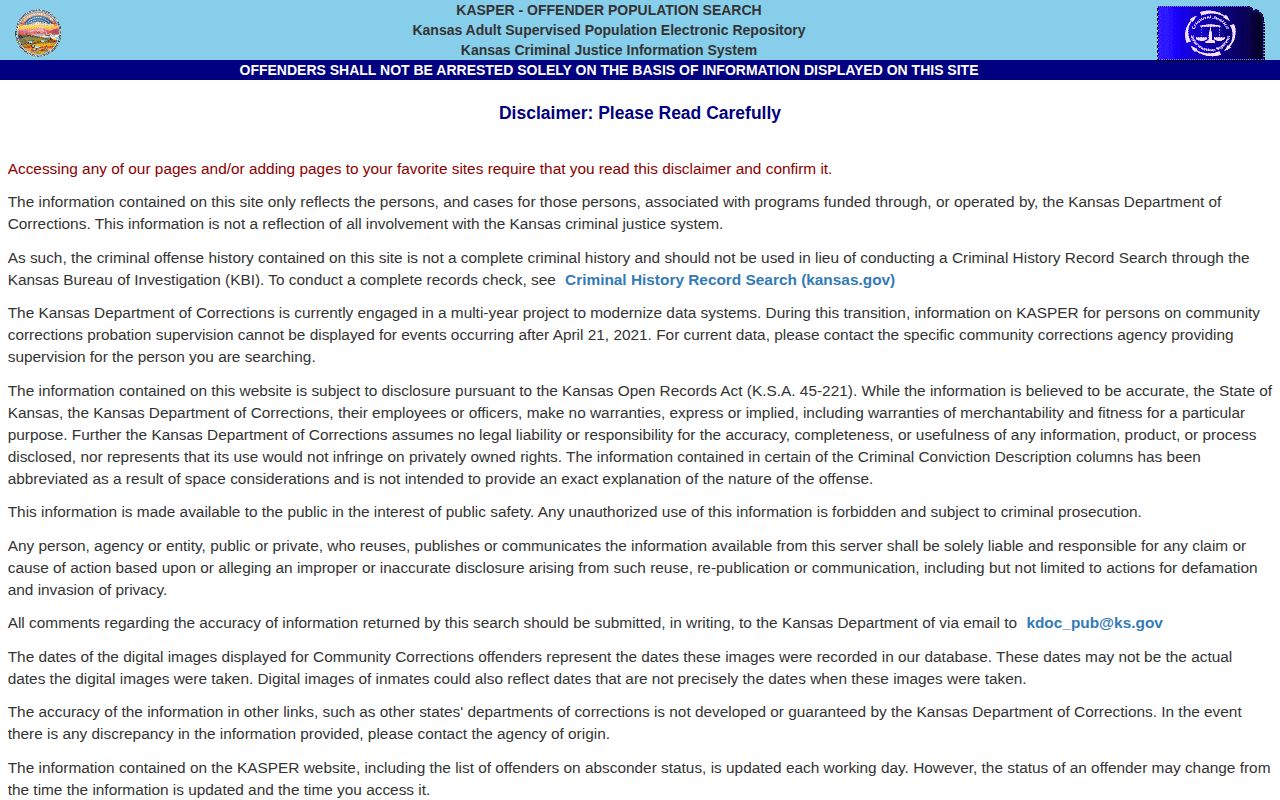
Labette filters help narrow the search, but they do not prove current location or a county-jail release.
Labette County Recent Release Search
Labette has an official Released view, and the sheriff's 2020 launch announcement describes it as covering people released within the last 48 hours. It is not an official 24-hour or 72-hour product. Use its timestamps for the period being checked. Cards can show a photograph, name, booking and release times, booking number, charges, bond, and profile link.
During the July 18, 2026 review, the Released URL showed older entries while the home page showed a same-day release card. Treat either display as a lead, preserve the profile, compare VINE, call staff, and request the record when needed. The Labette Jail Releases: 24 Hours guide explains how to narrow the official 48-hour view.
The sheriff's home page supplies a useful second official view.
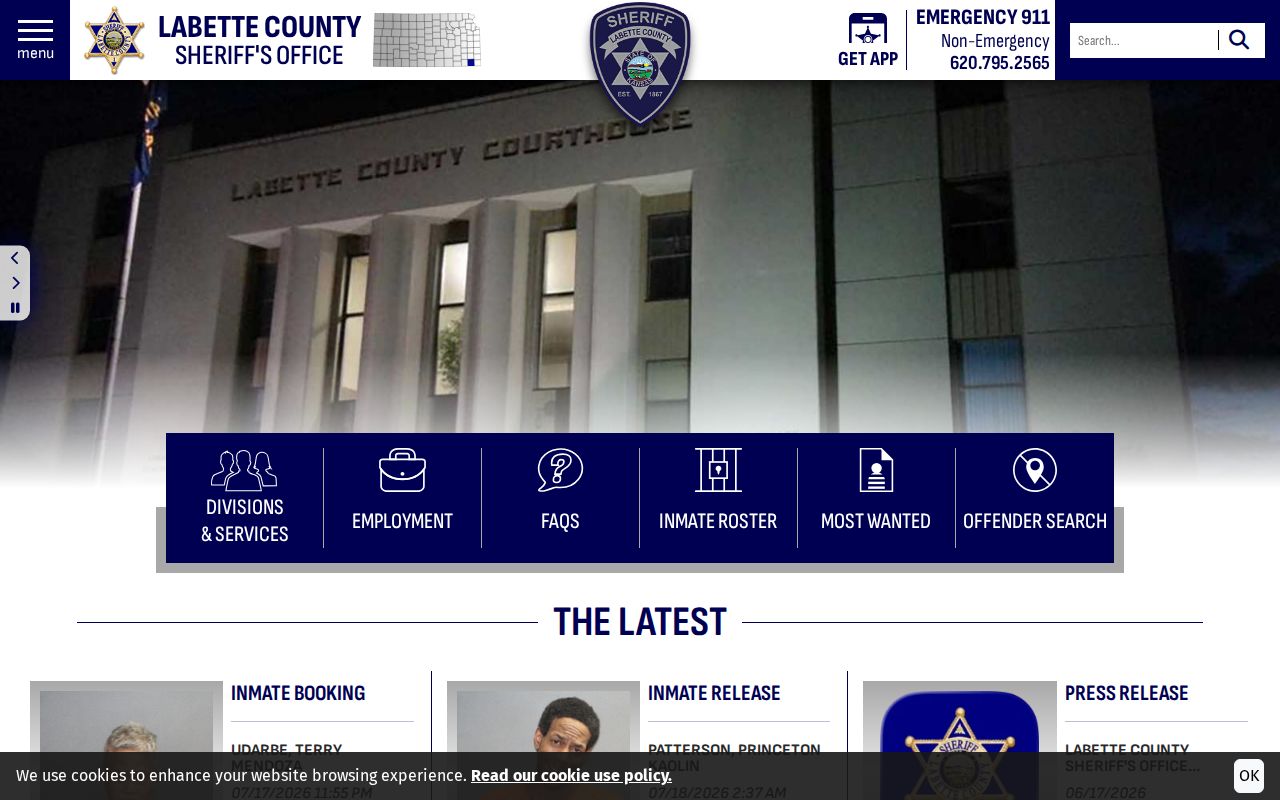
Compare the card with the Released filter and booking profile rather than assuming one screen is complete.
Labette Release Supervision and Care
Release can begin a supervised phase. KDOC handles parole and statutory postrelease supervision. District Court Services or 11th Judicial District Community Corrections may handle probation. KASPER helps with KDOC cases, while the sentencing docket and local office are stronger for community-corrections cases affected by KASPER's gap. Absconder lists address alleged loss of contact, not discharge.
Labette Center for Mental Health Services describes an in-jail assessment and continuity program for active clients so care can continue after release. This is a local navigation point, not a promise that every released person is eligible. Final discharge comes later when a sentence or supervision ends.
Labette Release Property and Errors
The sheriff's self-surrender instructions say personal items are stored during intake, but no public release-property return procedure, exit, waiting location, or transportation-home arrangement was found. Call the jail about physical property and release logistics. Intake instructions do not establish the return process.
A KASPER data issue follows another route. KDOC directs accuracy corrections in writing to kdoc_pub@ks.gov. Keep the county booking, court case, and KDOC number distinct. A court date and a KDOC date may describe different events, so a difference is not automatically an error.
Labette Courts Preserve Release Evidence
Labette's district-court locations have different roles. The Parsons Judicial Center at 201 South Central Avenue handles the broader criminal docket and is open Monday through Friday from 8:00 a.m. to 4:00 p.m. Its phone is 620-421-4120. The Oswego courthouse at 417 Merchant Street, third floor, provides more limited criminal, traffic, and fish-and-game service, with court generally on the third Thursday.
The statewide District Court Records portal may preserve a bond order, dismissal, sentence, jail credit, probation order, revocation, or discharge after the roster entry disappears. Match case and charge details. A docket supplies legal authority, not physical departure, so pair it with the sheriff timestamp or staff confirmation.
Labette Release Alerts and Transfers
Kansas VINE covers adults in participating county jails, including Labette County Jail. The sheriff places a direct VINE link on profiles. A phone or email notice can report release, transfer, or escape, so read the event type. VINE does not cover offenders housed in KDOC prisons. A state transfer requires KASPER and KDOC's separate notification route.
Federal and immigration custody use other tools. The BOP locator covers federal inmates from 1982 onward. Released or Not in BOP Custody means only that BOP does not hold the person. ICE ODLS uses an A-number and country of birth, or biographical fields, and its no-result is also limited. PACER, USMS, the holding jail, or the custody-event record may close the gap.
Choose the Labette Release System
Use the system that owns the stage being checked. Current custody, a closed county booking, state supervision, and federal custody are separate questions. Negative results should be stated just as narrowly.
| Question | Starting point | What it establishes |
|---|---|---|
| Still in Labette jail? | Current roster and staff | Current display or direct confirmation. |
| Recent booking ended? | Released profile and custody-event record | Timestamp, plus reason or destination if recorded. |
| Moved into KDOC? | KASPER, KDOC Records, court | State-system status within published scope. |
| County-jail change alert? | Kansas VINE | Reported release, transfer, or escape event. |
| Federal prison custody ended? | BOP and PACER | BOP status plus the legal record. |
| Immigration custody lead? | ICE ODLS and case record | A limited locator result. |
Which Labette Release Facility Applies?
The Labette County Jail release page covers the county's one verified active detention facility. The current building opened in 1983 with space for 40 people and expanded in 1996 to 84 beds. Release paths include community return, KDOC transport, another jurisdiction, federal or immigration custody, court, extradition, and medical movement.
No active state prison, federal prison, ICE detention center, or separate municipal jail was established in Labette County through the official sources reviewed. The former Labette Correctional Conservation Camp is historical. KDOC reported that its contract ended and the camp closed in fiscal year 2009. It is not a current search destination.
Public Record Search
Sponsored Results