
Labette Parole and Probation Paths
Parole and probation are often treated as synonyms, but they begin under different authority. Kansas parole generally concerns an eligible person serving an older indeterminate prison sentence. The Kansas Prisoner Review Board decides whether release may occur, subject to processing and conditions. Probation is a court sentence served in the community instead of, or after a limited period of, confinement. The sentencing docket is the best starting record for probation.
Modern Kansas guidelines cases add another category. Mandatory postrelease supervision begins after the prison portion of a guidelines sentence ends. It is supervised in the community but is not the same as a discretionary parole grant. Labette County also participates in the 11th Judicial District Community Corrections program, which serves Labette, Cherokee, and Crawford counties. Court Services handles other district-court probation work.
| Status | Authority and record | Best verification path |
|---|---|---|
| Parole | Prisoner Review Board release for an eligible prison sentence | KASPER, the Board process record, and KDOC Community and Field Services |
| Postrelease | Supervision after the prison part of a guidelines sentence | KASPER and KDOC records |
| Court probation | Supervision ordered in a district-court case | Sentencing docket and 11th Judicial District Court Services |
| Community corrections | Intensive local supervision through the three-county program | Court docket and 11th Judicial District Community Corrections |
| Discharge | Formal end of the sentence or supervision term | KDOC discharge certificate or court order, as applicable |
- Parole eligibility
- The point when a qualifying prisoner may be considered. It is not a release promise.
- Postrelease supervision
- A mandatory community-supervision period after the prison portion of a guidelines sentence.
- Discharge
- The formal end of custody and supervision, which can occur well after release from confinement.
Verify Labette Post-Release Supervision
A reliable check starts with the kind of case, not a guess based on where the person lives. KASPER, the Kansas Adult Supervised Population Electronic Repository, covers people and cases tied to KDOC-operated or funded programs. Search by KDOC number when known. A name search can be narrowed with birth data, conviction county, supervision county, and the photo option. Labette may be selected as a conviction or parole-supervision county, but that does not prove the person is now in Labette County.
- Identify the Labette County case number and read the sentencing or revocation entries in the Kansas district-court portal.
- Search KASPER for a KDOC number or a carefully matched name. Note the lookup date because the repository updates on working days.
- Determine whether the record concerns parole, postrelease, or a KDOC-funded community program. Do not turn a general status into a specific office assignment.
- If KASPER has no useful result, contact Court Services or 11th Judicial District Community Corrections with the case information.
- For formal proof that supervision ended, request the discharge certificate, order, or other public record from the office that maintains it.
KASPER warns that it may not contain complete community-corrections information for events after April 2021. A no-result therefore does not disprove probation. Recent changes may also wait for a working-day update. Reconcile the state display with the court docket and the supervising office before treating a status as current.
Labette Supervision Offices and Records
The 11th Judicial District covers Labette County. Its Community Corrections program is administered with Cherokee and Crawford counties, while district Court Services works through the courts. An office can confirm routing within lawful public limits, but protected case-management notes are not made public simply because a person is outside custody.
Local and state channels
11th Judicial District Community Corrections
410 E. Atkinson, 3rd Floor
Pittsburg, KS 66762
620-232-7540
KDOC Central Office
714 SW Jackson, Suite 300
Topeka, KS 66603
785-296-3317
KDOC Records Division
785-746-7482
Use the Labette court docket to identify the ordered program before calling. For parole or postrelease, the relevant public route is KDOC Community and Field Services and KASPER. For court probation, ask the district-court clerk or Court Services where the case is assigned. The 11th Judicial District directory identifies the Labette court structure.
Labette Absconder Records Differ
KDOC publishes a parole absconder list and a separate community-corrections absconder list. They answer different questions. An entry means the agency reports a loss of contact under that supervision program. It does not prove the person’s present location, and it should not be treated as a complete warrant search.
K.S.A. 75-5217 explains the parole-supervision response to an alleged violation or absconding, including notice or warrant procedures and possible effects on sentence credit. Because both public lists are subject to working-day updates, confirm an entry with the listed agency. The court docket may show a probation violation filing or revocation order. Kansas VINE serves county-jail custody notices, not ongoing KDOC prison or parole status, so it is not the primary supervision checker.
The parole absconder source is shown below. It should be read as a dated lead and paired with a current agency response.
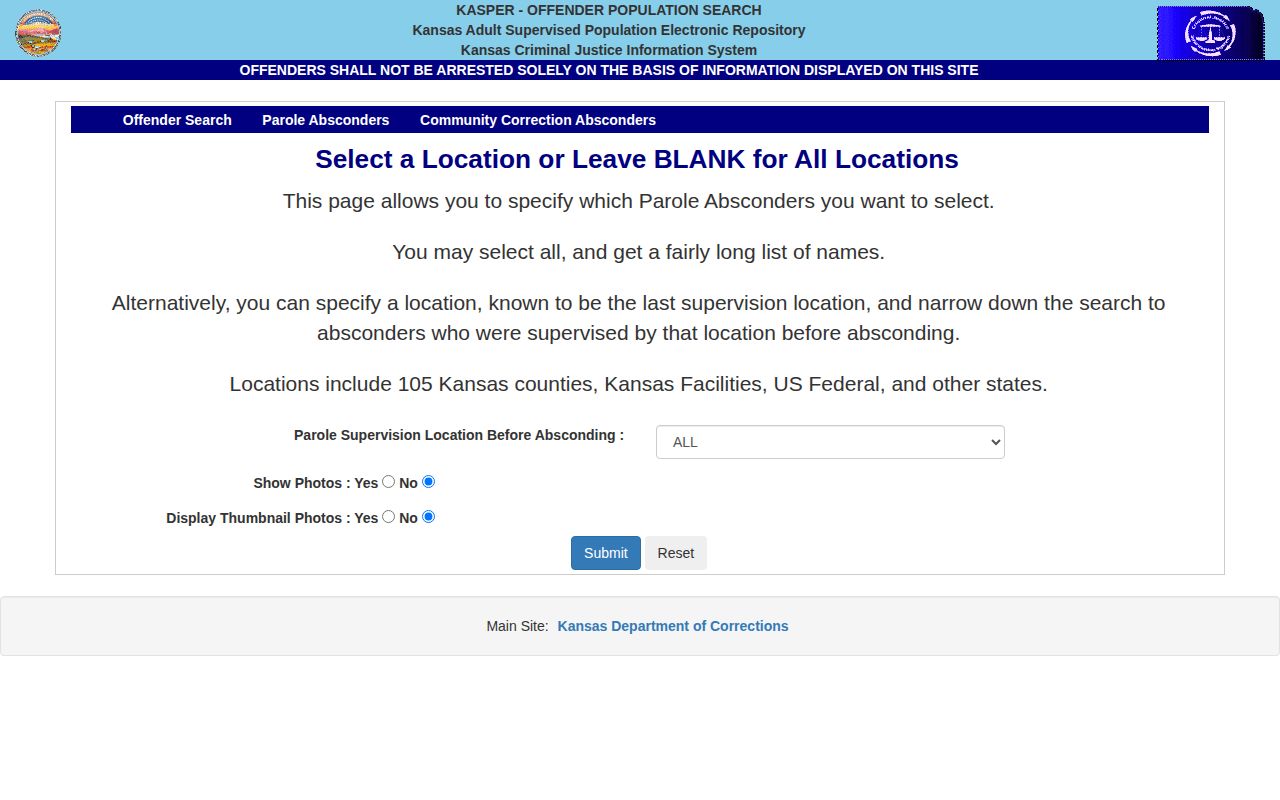
The separate community-corrections page must be checked when the sentencing record points to that program.
How Labette Supervision Ends
Release from a jail or prison is not final discharge. A person may leave confinement and begin parole or postrelease supervision. K.S.A. 22-3722 provides a certificate or order route for final discharge in specified parole and conditional-release cases. The record should preserve separate dates for release from confinement, the start of supervision, and final discharge.
The Prisoner Review Board keeps records of its acts under K.S.A. 22-3710, but K.S.A. 22-3711 protects preparole reports, supervision histories, and other specified material. A focused request should ask for the public decision or discharge document, not the protected case file. The full Labette custody-event path and records-request fields are available from the released-inmate search home page.
Labette Parole Hearing Evidence
The Prisoner Review Board’s public-comment calendar and next-month offender list document a scheduled process. They are not individual decision searches. The list may identify an eligible person and hearing month, while a later outcome can be grant, pass, continue, or another Board action. Eligibility only means the case may be considered.
The Board’s process page defines the parole terms that matter when reading an older Labette sentence.

The image supports a careful distinction between a hearing, a favorable decision, processing, and an actual custody change. No public database of individual Board decisions was found, so later KASPER status, KDOC confirmation, and a focused record request remain necessary.
Labette Release Care Continuity
Labette Center for Mental Health Services describes work inside the jail and continuity after release. That local bridge matters because community supervision and treatment are separate systems. A release record can establish when the jail episode ended, while the supervising office establishes legal conditions and the care provider handles services with proper consent.
The practical sequence is to identify the correct supervision office, preserve any upcoming court or reporting date, and arrange care through the provider’s normal intake path. Do not ask a public-record custodian for protected health details. The distinctive local point is continuity: a person may move from jail-based services to community care without the treatment record becoming part of the public release card.
Labette KASPER Limits Matter
KASPER is a public derivative of KDOC records, not a complete criminal history. It may omit a county-jail-only episode and warns that recent community-corrections events after April 2021 may be incomplete. Its working-day update cycle can also leave a recent supervision change absent for a time. A no-result is therefore a narrow finding.
When KASPER appears wrong, use the written correction channel and preserve the response. Do not replace its date with a court date merely because the court record seems more familiar. One date may describe sentencing, another release from prison, another the start of supervision, and another final discharge. Label each event by its source.
A conviction county filter is a search aid, not proof of current assignment. Someone convicted in Labette may be supervised elsewhere. Conversely, a person living in Labette may have a case from another county. Confirm present office routing with the responsible agency after matching the KDOC number and court case.
Request Labette Parole Records
A precise request distinguishes public Board action from protected supervision content. Ask for the public record of the Board’s act, a final discharge document, or a specific decision tied to the KDOC number and hearing period. Do not demand preparole reports, supervision histories, or protected case-management material.
K.S.A. 22-3710 requires a record of Board acts, while K.S.A. 22-3711 protects specified records. That split explains why a public schedule may be available even when the underlying reports are not. If no individual decision search exists, later KASPER status and a focused KDOC response are the proper follow-up.
Public Record Search
Sponsored Results